
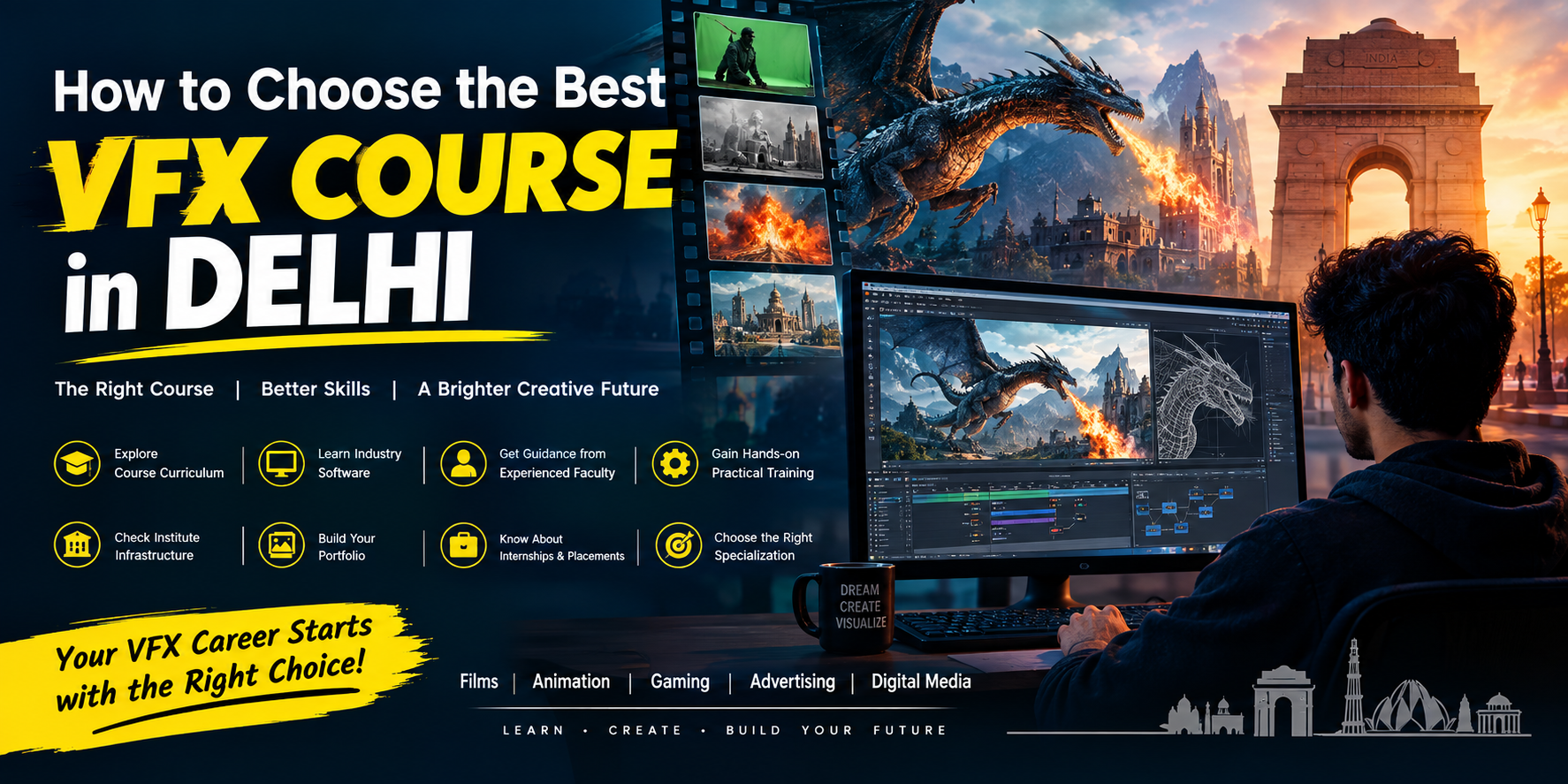
Visual effects (VFX) has become an important part of the entertainment, advertising, gaming, television, and digital media industries. From creating realistic environments in movies to designing impressive visuals for advertisements and web content, VFX professionals play an important role in modern media production. As demand for skilled VFX artists continues to grow, many students and creative professionals are looking for the right VFX course in Delhi to develop their skills and build a successful career.
However, with numerous institutes and courses available, choosing the right program can be challenging. A course that looks attractive in advertisements may not necessarily provide the practical training, software knowledge, and career support you need. Before enrolling, it is important to evaluate several factors carefully.
1. Understand Your Career Goals
The first step in choosing a VFX course in Delhi is understanding what you want to achieve. VFX is a broad field that includes several specializations, such as 3D modeling, animation, compositing, motion graphics, rotoscoping, match moving, lighting, texturing, and visual effects production.
If you are interested in creating characters and environments, you may want to focus on 3D modeling, texturing, and animation. If you enjoy combining computer-generated elements with live-action footage, compositing may be a better choice.
Having a clear career goal will help you select a course that matches your interests instead of choosing a program simply because it is popular.
2. Compare VFX Course in Delhi Fees and Duration
A strong curriculum is one of the most important things to consider when selecting a VFX course in Delhi. Look for a program that covers both fundamental concepts and advanced techniques.
The curriculum should ideally include subjects such as:
- 2D and 3D design
- 3D modeling and animation
- Texturing and lighting
- Compositing
- Motion graphics
- Rotoscoping
- Match moving
- Chroma keying
- Visual effects production
- Rendering
- Portfolio and showreel development
A good curriculum should also be updated regularly according to changes in industry practices and software.
3. What to Look for in a VFX Course in Delhi
VFX professionals work with specialized software, so practical software training is essential. Before joining a course, find out which applications are included in the curriculum.
Depending on the specialization, students may work with software used for 3D modeling, animation, compositing, editing, motion graphics, and digital design.
More importantly, don’t choose a course simply because it lists a large number of software applications. The quality and depth of training matter more than the number of programs mentioned in the brochure.
Ask whether students receive enough hands-on practice and whether they complete projects using the software.
4. Choose the Right VFX Specialization
VFX is a practical profession. Watching demonstrations or attending theoretical classes is not enough to become job-ready. Therefore, practical training should be a major factor when choosing a VFX course in Delhi.
Find out how much time students spend working on actual projects. A good program should provide opportunities to create visual effects, work with footage, solve production problems, and develop creative solutions.
Practical assignments can also help students understand how different stages of VFX production work together.
5. Review the Faculty Experience
Experienced instructors can make a significant difference to your learning experience. Before enrolling, research the faculty members and their professional backgrounds.
Look for instructors who have practical industry experience in areas related to the course. Professionals who understand real production workflows can often provide insights that go beyond textbooks and software tutorials.
You can also ask about the teaching methodology. Find out whether classes involve demonstrations, individual feedback, practical assignments, and project reviews.
6. Check Student Portfolios and Showreels
One of the best ways to evaluate a VFX institute is by looking at the work produced by its students. Ask to see student portfolios, showreels, animation projects, and visual effects assignments.
Pay attention to the quality and variety of the work. This can give you an idea of what students are actually able to create after completing their training.
A strong portfolio is particularly important when applying for jobs because employers often want to see practical skills rather than just course certificates.
7. Consider Placement and Career Support
Career support is another important consideration when selecting a VFX course in Delhi. Ask the institute about its placement assistance and career services.
Instead of relying only on placement claims, ask specific questions:
- Does the institute provide interview preparation?
- Does it help students create professional showreels?
- Are there internship opportunities?
- Does it organize industry interactions?
- How are job opportunities communicated to students?
- Does the institute have relationships with relevant companies?
Remember that no institute can guarantee a successful career. Your skills, portfolio, creativity, communication abilities, and consistency will also play an important role.
8. Compare Course Duration and Fees
VFX courses can vary significantly in duration and cost. Some programs are designed for beginners, while others focus on advanced or specialized training.
Do not select a course solely because it is inexpensive. Similarly, a high course fee does not automatically mean better training.
Compare the overall value of each program. Consider the curriculum, practical training, faculty, software access, projects, infrastructure, portfolio development, and career support.
Make sure you understand whether there are additional costs for software, examinations, equipment, or other resources.
9. Visit the Institute Before Enrolling
If possible, visit the institute before making your final decision. A campus visit can help you understand the learning environment and facilities.
Check whether the classrooms and computer labs are suitable for VFX training. Ask whether students have sufficient access to computers and software for practice.
You can also speak with current students and ask about their experiences. Their feedback may provide useful information that is not available in advertisements or brochures.
10. Ask About Projects and Portfolio Development
A professional portfolio is one of the most valuable outcomes of VFX training. Therefore, choose a course that allows you to work on multiple projects throughout the program.
Projects should ideally demonstrate different skills and techniques. As you progress, you can select your strongest work and develop it into a professional showreel.
When comparing a VFX course in Delhi, ask how many major projects students complete and whether instructors provide feedback during the process.
11. Compare VFX Course in Delhi Fees and Duration
Location may seem like a minor factor, but it can affect your overall learning experience. Choose an institute that you can reach comfortably and consistently.
Delhi has students from different parts of the National Capital Region, so consider travel time, class schedules, infrastructure, and accessibility before enrolling.
A convenient location can make it easier to attend classes regularly and spend additional time practicing your skills.
12. Check the VFX Course Curriculum
Online reviews can help you compare different institutes, but they should not be your only source of information. Read reviews from multiple platforms and look for detailed experiences rather than relying only on star ratings.
You can also search for alumni work and professional profiles to understand what previous students are doing after completing their training.
Try to combine online research with an institute visit, curriculum comparison, faculty evaluation, and student feedback.